
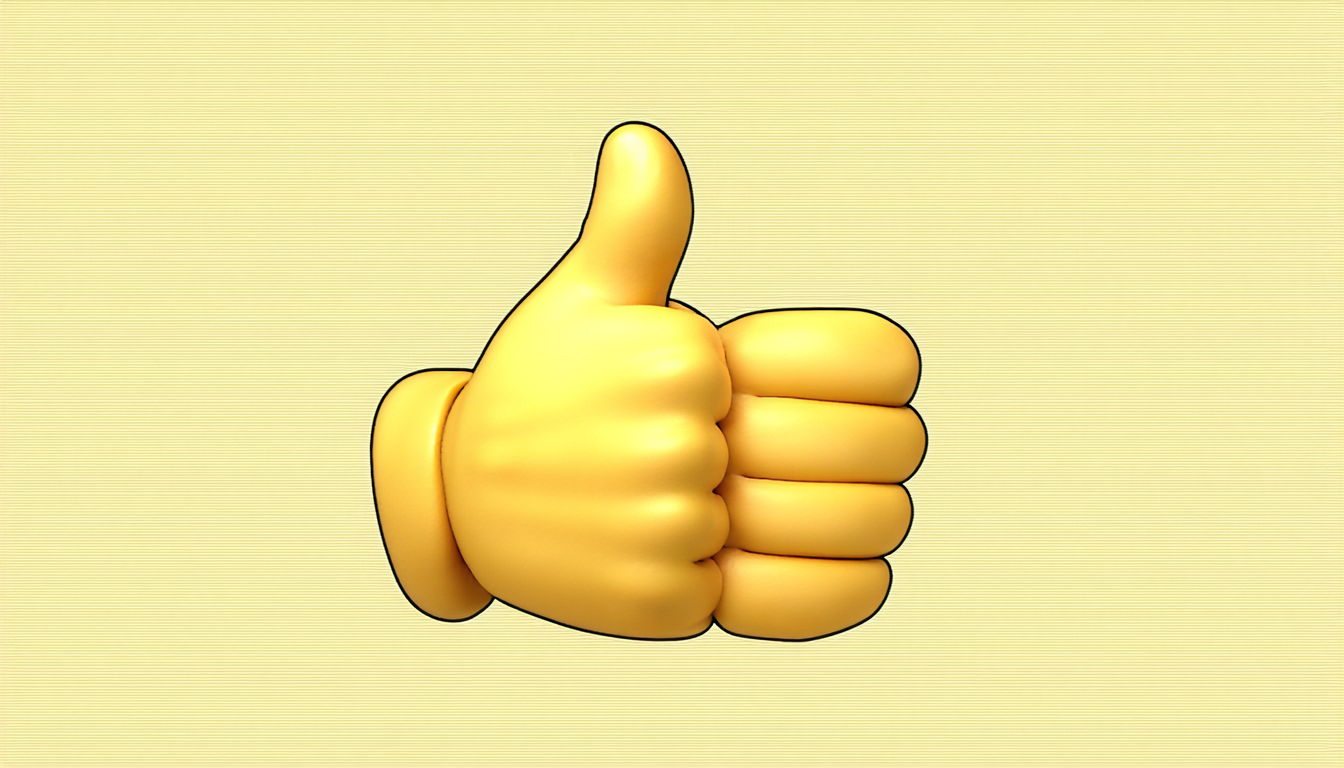

An everyday staple of digital chat—yet hardly ever just a casual icon—the thumbs‑up emoji (👍) carries a surprisingly nuanced language all its own. Used to signal approval, agreement, or acknowledgment, it also rides on layers of cultural and generational meanings. Here’s a closer, human-tinted look at its journey, how it’s used today, and that handy copy-paste how-to.
A Brief History and Cultural Evolution
The thumbs‑up gesture stretches far back—most notably entering public consciousness via ancient Rome. But contrary to cinematic lore, thumbs‑up did not mean “spare him”—that was either a thumb pressed into a fist or something else entirely. In fact, evidence suggests thumbs‑up indicated death, while a closed fist may have signaled mercy (time.com). Depictions like Jean-Léon Gérôme’s influential “Pollice Verso” painting muddied interpretations further, later feeding into modern misunderstandings (en.wikipedia.org).
Fast-forward to the 20th century: in World Wars I and II, the gesture found new meaning. American pilots flashed thumbs‑up before takeoff, while soldiers used it to say “everything’s fine”—this is how the modern positive connotation really stuck (en.wikipedia.org).
Today, Unicode added it as U+1F44D in version 6.0 (released 2010), with skin-tone variants arriving in 2015 (dictionary.com).
How People Use the Thumbs‑Up Emoji Today
At face value, the thumbs‑up emoji is a thumbs-up—it’s a universal nod of approval, agreement, or casual positivity. Phrases like “sounds good,” “got it,” or “nice work” often come with 👍 to punctuate brevity (emojiable.com). Bulleting some everyday uses:
- Signaling acknowledgment (“OK, I saw your message”)
- Saying “well done” or supportive cheer
- Serving as a quick positive reaction in chats or social media
Yet beneath its simplicity lies a layered social fabric. Sometimes it’s just polite brevity; other times, a strategic—or even passive-aggressive—pause. For example, “Way to ruin the party 👍” flips positivity on its head with sarcasm (dictionary.com).
Generational and Cultural Interpretations: Not Always What You Think
In the workplace, especially between generations, reactions vary starkly. Among Gen Z professionals, the thumbs‑up emoji can imply low effort or curt dismissal—like “I’m done talking” (forbes.com). A recent survey reveals that nearly one in four Gen Zers find it rude in workplace communications (forbes.com). More broadly, 65% of workers across generations report using emojis to convey tone—but while 88% of Gen Z find them helpful, only 49% of Boomers or Gen X feel the same (phys.org).
Cultural meanings shift as well. In certain parts of the Middle East, the thumbs‑up can come off like a middle finger; in some African regions, it’s similarly offensive (nypost.com). That makes a seemingly innocent 👍 something to deploy carefully when international or cross-cultural communication is involved.
Copying and Pasting the Thumbs‑Up Emoji
Getting the emoji into your message is straightforward, but here’s a quick guide:
- On Windows: Press
Win + .to open the emoji picker, then search “thumbs up.” - On macOS: Use
Cmd + Ctrl + Spaceto open the emoji panel. - On mobile (iOS/Android): Tap your emoji keyboard and find 👍 manually.
- You can also simply select and copy it from anywhere it’s displayed in text.
Platforms may show slightly different artwork (Apple’s is left‑handed yellow, Facebook’s is right‑handed, for example), but the intent carries through.
Expert Insight
“Generational divides around emojis like thumbs‑up reveal not just differences in communication style but in assumed intent. What one person sees as efficient, another may perceive as dismissive.”
— a communication analyst (paraphrased reflection)
This underscores the importance of context in digital expression—what looks neutral to one can sting for another.
Quick Reference: Pros & Cons of Using 👍
- Pros:
- Fast, efficient way to say “yes,” “got it,” or “thumbs up.”
- Positive in most casual, informal contexts.
-
Universally supported across major platforms.
-
Cons:
- Can be misread as curt or passive-aggressive, especially by younger coworkers.
- May offend or confuse in some cultures—Middle East, parts of Africa, etc.
- Lacks emotional nuance—sometimes needs clarification or follow-up.
Concluding Thoughts
The thumbs‑up emoji is more than just a digital shorthand—it’s a gesture rich with history, cultural shifts, and generational nuance. Its roots echo ancient gladiatorial arenas, its modern meaning shaped by war pilots, and today it dances to the delicate tune of office norms and global etiquette.
When used thoughtfully—with awareness of your audience and context—👍 remains a handy, positive symbol. But like any language, it works best when chosen consciously, not just autopilot. Think of it as a small but expressive nod, rather than a one-size-fits-all response.
This breakdown aimed to balance clarity and authority with a human touch—and hopefully comes off as thoughtful, not over‑polished.






Leave a comment