
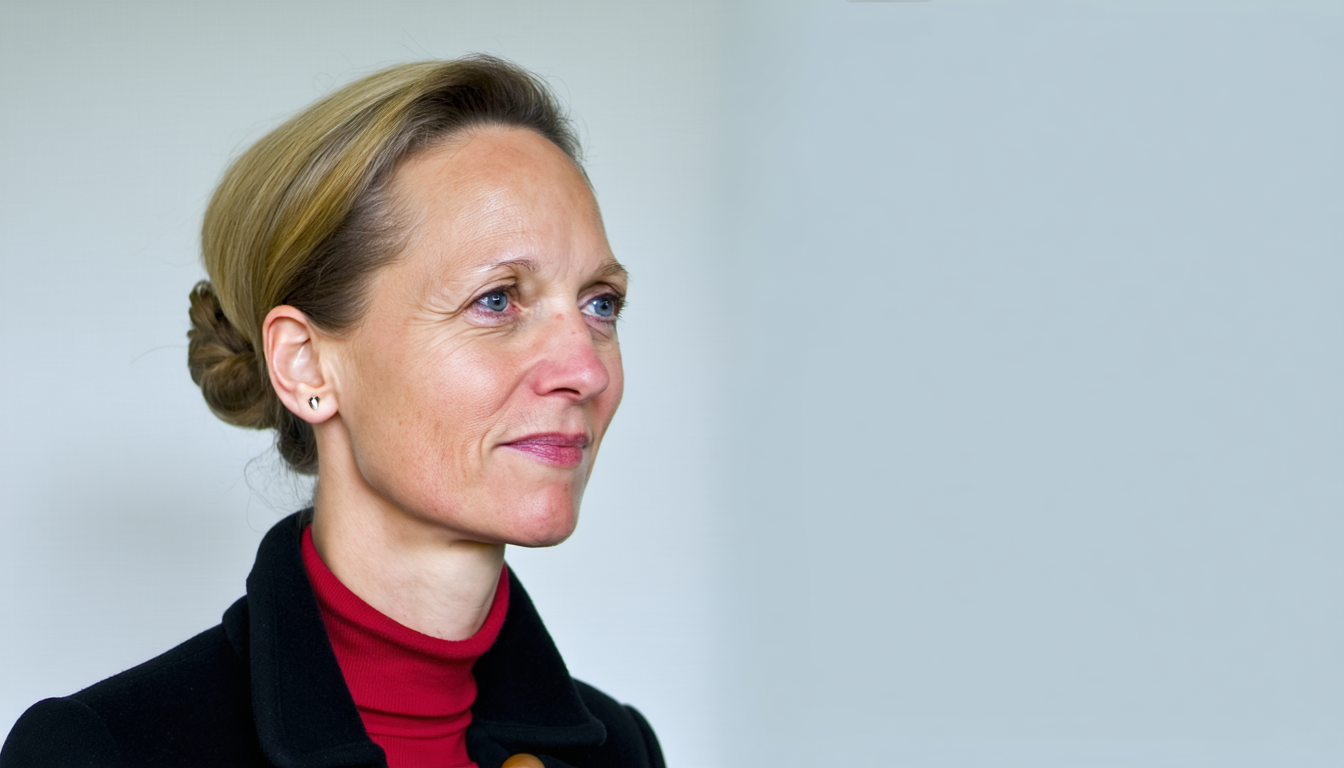

An exploration into Alice Weidel’s emergence as a central figure in German politics, tracing her background, political path, and the convictions shaping her influence.
Political Ascent and Roles
Alice Elisabeth Weidel, born February 6, 1979, in Gütersloh, has steadily ascended within the Alternative for Germany (AfD), emerging as one of its most visible leaders. Since joining the party in 2013—drawn by euro skepticism—she rapidly rose to prominence, securing a position on the federal executive committee by 2015. Her breakthrough came in 2017 when she became co-lead candidate for the Bundestag alongside Alexander Gauland, subsequently becoming leader of the AfD’s parliamentary group .
Since June 2022, she has served as co-leader of AfD, alongside Tino Chrupalla, and is currently the Leader of the Opposition in the Bundestag—a role she assumed in May 2025, following the FDP’s Ralph Brinkhaus . Her selection as AfD’s chancellor candidate for the February 2025 early federal elections marked a first in the party’s history .
Personal Background and Unexpected Contrasts
Weidel’s profile defies expectations for a far-right party figure. Educated in economics at the University of Bayreuth, she worked for Allianz Global Investors and as a business consultant, with overseas experience in China and at Goldman Sachs . Openly lesbian, she lives in Switzerland with her Sri Lankan-born partner and their two adopted sons—an identity incongruent with AfD’s traditional social values .
Political scientists highlight this contrast: Andreas Busch notes she “does not exactly have the sociodemographic characteristics you’d expect from an AfD voter,” while Der Spiegel dubbed her the party’s “perfect fig leaf” . Wolfgang Schroeder went further: “This election campaign has made clear that (Weidel) is the uncrowned queen of the AfD,” underscoring her growing clout .
Key Policy Positions and Messaging
Economic and EU Stance
Weidel’s economic ideology is firmly liberal: she admires Margaret Thatcher, favors tax cuts, opposes inheritance tax and minimum wage legislation, and champions economic liberalism . A staunch euroskeptic, she initially advocated Germany’s exit from the euro and a return to a gold-backed currency . By early 2025, though, she admitted that a return to the Deutsche Mark is “far too late”—yet warned of a chaotic Eurozone collapse .
On the EU, she argues for reform from within and the dismantling of what she calls a “corrupt” bureaucracy. In 2025, she acclaimed Hungary under Viktor Orbán as a model, emphasizing shared priorities on immigration and EU restructuring .
Immigration, Foreign Policy, and Energy
Weidel is known for hardline immigration positions. At the AfD federal conference in January 2025, she advocated for “remigration” and mass deportations, declared borders closed, and called for dismantling the European asylum system. She criticized climate policy as “ideological madness,” pledged to reactivate nuclear and coal plants, restart Nord Stream, and demolish wind turbines .
Her foreign policy stance is similarly stark. She dismissed Germany’s sanctions on Russia as self-harming and called the conflict between Ukraine and Russia “not our issue.” She also downplayed accountability for Putin’s actions .
Climate Change and Energy
A noted climate skeptic, she questioned human influence on global warming and cited fringe science as support . She denounced climate activism as “cumulative stupidity” and pledged to end Germany’s commitment to renewables, even reviving fossil fuel and nuclear infrastructure .
Campaign Influence and Election Outcome
During the 2025 campaign, Weidel gained visibility through high-profile appearances, including a live-streamed session with Elon Musk on X . Musk repeatedly boosted AfD as a savior of Germany. Meanwhile, Viktor Orbán hosted her in Budapest in February 2025, praising AfD as “the future of Germany” .
The AfD achieved its best-ever performance in the February 2025 election, securing just under 21% of the vote and becoming the second-largest party behind CDU/CSU . Weidel hailed younger support as an “indicator that we are the party of the future,” and called for mainstream parties to drop the so-called “firewall” blocking AfD cooperation .
Recent Actions and Controversies
Post-election, Weidel demanded early elections in Brandenburg amid government instability, citing AfD’s strong polling at 35% as a reason . She also faces public criticism for her connections with Theo Müller, a dairy businessman, which sparked nationwide protest campaigns over perceived coziness with far-right politics .
Narrative of Influence and Controversy
Alice Weidel embodies complexity: a neoliberal economist with global financial experience, who espouses nationalist, anti-immigration, and climate-skeptic policies. Her personal identity—openly lesbian, western German, partnered with a migrant—clashes with her party’s conservative ethos. Yet this paradox has enabled her to soften AfD’s image and boost its appeal: “she has helped somehow to detoxify it in the eyes of some voters” .
“The AfD is now firmly anchored as a people’s party,” she proclaimed. Her dual strategy—courting the radical wing while presenting a polished public face—has consolidated her leadership, but the road ahead remains fraught. Can she transition from opposition figurehead to credible governing force?
Conclusion
Alice Weidel stands out as an unconventional and controversial architect of the AfD’s rising influence. Her blend of elite economics, nationalist policies, and personal incongruity evince both strategic savvy and ideological flamboyance. While she has propelled the AfD to its best electoral showing, systemic resistance from other parties and public outrage over far-right ties remain significant hurdles. Her future will depend on whether she can sustain internal cohesion, broaden appeal, and seize openings created by Germany’s polarized political landscape.
FAQs
Who is Alice Weidel?
Alice Weidel is a German far-right politician, co-leader of the Alternative for Germany (AfD) since 2022, and Leader of the Opposition in the Bundestag as of May 2025. She has served as the party’s Bundestag group head since 2017 .
What notable roles has she held?
Her career includes leadership of AfD in the Bundestag, co-leadership of the party, and being the first AfD chancellor candidate in early 2025. Before politics, she held roles in finance and consulting .
What are her political stances?
Ideologically, she combines economic liberalism (tax cuts, no minimum wage) with nationalist and hardline policies on immigration, Euroskeptic reform, energy reorientation (nuclear and fossil fuels), and EU restructuring .
How does her personal background contrast with her party’s values?
Despite leading a socially conservative party, she is a lesbian married to a Sri Lankan-born woman and lives transnationally—highlighting a tension between her identity and her party’s traditionalist agenda .
How did the AfD perform under her leadership in the 2025 election?
AfD achieved its best-ever result, just under 21% of the vote, becoming the second-largest party, and secured a prominent place in parliament under her leadership .





Leave a comment