
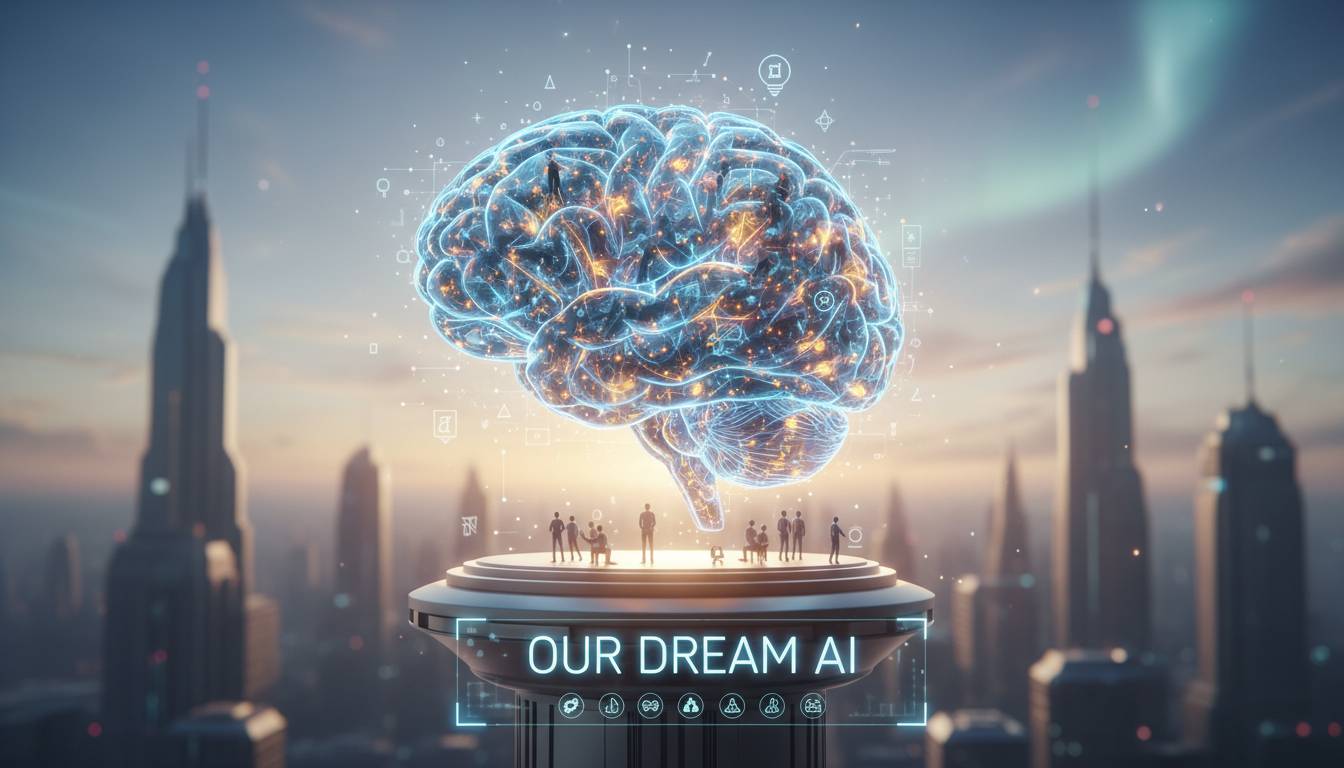

The concept of “our dream AI” represents the ideal artificial intelligence system that balances powerful capabilities with human values—a technology that enhances our lives without compromising privacy, security, or autonomy. This article explores what such a system would look like, how AI has evolved to this point, and the practical considerations that shape truly beneficial AI development.
What Is Dream AI and Why It Matters
Dream AI refers to an idealized artificial intelligence system that meets our deepest technological aspirations while respecting fundamental human needs. It is not merely a tool but a thoughtful partner in problem-solving, creativity, and daily life enhancement.
The importance of defining our dream AI now cannot be overstated. We stand at a pivotal moment in technological history where the decisions we make about AI development will shape decades of innovation. Every major tech company, research institution, and startup is racing to build the next generation of AI systems, but without a clear vision of what we actually want, we risk creating technologies that solve the wrong problems or create new issues we hadn’t anticipated.
When we talk about dream AI, we’re really talking about alignment—ensuring that the systems we build serve human interests. This means different things to different people. For some, dream AI means having a personal assistant that understands context and anticipates needs without constant supervision. For others, it means medical AI that can diagnose conditions with superhuman accuracy while explaining its reasoning in terms patients understand. And for many, dream AI means automation that handles tedious tasks, freeing humans to focus on creative and meaningful work.
The concept matters because it gives us a north star. Without a shared vision of what we want AI to become, we drift toward whatever seems technically impressive rather than genuinely beneficial. Dream AI serves as both a goal and a constraint—a description of what we should build and a warning about what we should avoid.
The Evolution of Artificial Intelligence
To understand where we’re going, we need to understand where we’ve been. Artificial intelligence has undergone remarkable transformations since the term was first coined in the mid-1950s. Early AI research focused on symbolic reasoning—using explicit rules to simulate human thought processes. These systems could solve complex mathematical problems and play chess, but they struggled with the ambiguity and context that humans handle effortlessly.
The turn toward machine learning marked a fundamental shift. Rather than programming rules explicitly, researchers began building systems that learn patterns from data. This approach proved extraordinarily successful for tasks like image recognition, speech processing, and language translation. The more data these systems received, the better they became—a phenomenon that led to today’s massive neural networks trained on unprecedented volumes of information.
The most recent chapter involves large language models and multimodal AI systems that can generate human-like text, create images from descriptions, and engage in something approaching natural conversation. These systems represent genuine leaps in capability, but they also expose the gaps between current technology and our aspirations. They can produce fluent language while making basic factual errors. They can generate beautiful images while misunderstanding physical causality. They can pass exams designed for humans while lacking common sense about everyday situations.
This evolutionary path tells us something important: AI progress is not a straight line toward superintelligence. Each generation solves some problems while revealing new limitations. Dream AI, therefore, must be understood not as a final destination but as an ongoing project of refinement and alignment.
Key Features of an Ideal AI System
What exactly should our dream AI look like? While specific implementations will vary, several core features define the ideal system from both technical and user perspectives.
Transparency and Explainability
Users deserve to understand how AI systems reach their conclusions. When a recommendation engine suggests a movie, when an AI assists with medical decisions, or when an automated system denies a loan application, the reasoning should be accessible. This isn’t just about trust—it’s about accountability. Without explainability, we cannot meaningfully oversee or correct AI behavior.
Dream AI would make its decision-making process visible while respecting complexity. Some decisions are inherently difficult to explain, but the system should at least be able to articulate what factors influenced its output and how much weight it gave to each factor. This creates a foundation for human oversight rather than blind reliance.
Contextual Awareness
Human communication is rich with context, implication, and nuance. We understand that “it’s hot in here” might be a request to open a window or a complaint about the meeting. Dream AI would grasp this contextual dimension, understanding not just the literal meaning of words but the intent behind them.
This extends to cultural context, personal history, and situational factors. The same words might mean different things in different contexts, and an ideal AI would navigate these subtleties with sophistication. This doesn’t mean AI should manipulate context to serve hidden agendas—it means understanding context to serve users better.
Reliability and Consistency
Perhaps nothing damages trust more than unpredictable behavior. When AI systems give different answers to the same question, users lose confidence. Dream AI would be consistent in its responses, explaining what it knows with confidence and acknowledging uncertainty honestly rather than confabulating plausible-sounding answers.
Consistency also means maintaining memory and context within interactions. Users shouldn’t have to repeat information they’ve already provided. The system should build a coherent model of each user’s needs and preferences over time.
Helpfulness Without Overreach
Dream AI assists without assuming control. It provides information when asked, suggests actions when helpful, but doesn’t push unwanted assistance or make decisions that should remain with humans. This balance requires the system to accurately assess when its input is wanted and when it’s better to wait.
The ideal system augments human capabilities rather than replacing human judgment. It handles the mechanical parts of tasks—the research, the organization, the calculation—while leaving meaningful decisions to people. This isn’t about limiting AI capability; it’s about respecting human agency.
Privacy and Security Considerations
Any serious discussion of dream AI must address privacy and security. These concerns aren’t just technical details—they’re fundamental requirements for a system that people will trust with sensitive aspects of their lives.
Data Minimization
Dream AI would collect only the information necessary to perform its functions. It wouldn’t vacuum up every possible data point “just in case” because that creates unnecessary risk. When data is collected, it should be stored securely with strong encryption and clear retention policies.
This principle extends to how the system operates. Ideally, much of AI processing would happen locally on user devices rather than sending everything to distant servers. Edge computing and on-device models represent important steps toward this vision.
User Control
People should have genuine control over their AI systems. This means meaningful choices about what data is collected, how it’s used, and when it’s deleted. It means the ability to opt out of certain features without losing access to the entire system. And it means clear, understandable settings that don’t require a computer science degree to navigate.
Control also means ownership. Users should own their data and their AI interactions. The system should make this explicit, clearly indicating what information belongs to the user and what the user can export or transfer.
Security Hardening
A dream AI system would be designed from the ground up with security as a core principle, not an afterthought. This means robust authentication, encrypted communications, regular security audits, and rapid patching of vulnerabilities. It means defending against both external attacks and internal misuse.
Security considerations also include preventing the AI from being used as a tool for harm. Dream AI would have appropriate safeguards against generating harmful content, assisting with illegal activities, or enabling harassment and exploitation.
Ethical AI Development
Building dream AI requires more than technical excellence—it demands careful attention to ethical considerations that shape who benefits from these systems and who might be harmed.
Bias and Fairness
AI systems learn from data, and that data reflects historical patterns, including human biases. The result can be systems that perpetuate or amplify existing inequalities. Dream AI would actively work to identify and mitigate these biases, ensuring fair treatment across demographic groups.
This requires diverse teams building and testing AI systems, comprehensive auditing for disparate impact, and ongoing monitoring after deployment. Bias mitigation isn’t a one-time fix but an ongoing commitment.
Accessibility
Technology only delivers on its promise when people can actually use it. Dream AI would be accessible to people with disabilities, older adults, non-native speakers, and those without technical backgrounds. This means designing for inclusion from the start rather than adding accessibility as an afterthought.
Accessibility also means affordability. Dream AI wouldn’t be available only to the wealthy, creating a digital divide that mirrors and amplifies existing economic inequalities. Reasonable pricing and tiered access models could ensure broader benefit.
Environmental Considerations
Training large AI models requires tremendous computational resources and energy. As AI capability has grown, so has its environmental footprint. Dream AI would be designed with efficiency in mind, achieving powerful results without excessive resource consumption.
This includes both the initial training of models and their ongoing operation. Techniques like model distillation, efficient architectures, and renewable energy-powered data centers can reduce AI’s environmental impact without sacrificing capability.
Real-World Applications
The abstract principles of dream AI become concrete when we examine specific application domains. Let’s look at how these ideals might manifest in practice.
Healthcare
Medical AI represents one of the most promising applications, with potential to improve diagnosis, personalize treatment, and extend quality care to underserved areas. Dream AI in healthcare would analyze symptoms and test results to suggest possible diagnoses, always presenting these as recommendations for physicians to evaluate rather than final judgments.
The system would explain its reasoning in terms both doctors and patients can understand, noting confidence levels and alternative possibilities. It would respect patient privacy, complying with regulations like HIPAA while still enabling the data sharing necessary for medical research. And it would be designed to augment physicians, not replace them, handling the information gathering and organization that takes up so much of doctors’ time.
Education
Personalized learning has long been an educational aspiration, and AI makes it more achievable. Dream AI in education would adapt to each student’s learning style, identifying knowledge gaps and adjusting difficulty appropriately. It would provide tutoring support available anytime, supplement rather than replace human teachers, and give students feedback that helps them improve.
Privacy is especially important when children are involved. Dream AI would comply with student privacy regulations, minimize data collection, and give parents meaningful control over how their children’s information is used.
Creative Work
AI can assist human creativity rather than replacing it. Dream AI in creative fields would serve as an ideation partner, helping artists, writers, and designers explore possibilities and overcome blocks. It would understand and respect creative intent, suggesting variations and alternatives without imposing its own vision.
Importantly, dream AI would be transparent about its nature as a tool, not a creator. It would help humans do what they want to do rather than steering them toward what the system prefers.
Personal Assistance
The dream of a truly helpful personal assistant—something like what science fiction has imagined for decades—remains compelling. Dream AI would manage schedules, handle routine communications, organize information, and anticipate needs based on learned preferences.
This requires deep integration with users’ digital lives, which makes privacy especially critical. The system would earn trust through consistent, helpful behavior and genuine user control over what it accesses and remembers.
Challenges and Limitations
Even with clear ideals, building dream AI faces significant obstacles. Honest assessment requires acknowledging these challenges.
Technical Hurdles
Current AI systems struggle with reasoning that humans find elementary. They can process vast information but often lack the causal understanding needed to make reliable predictions in novel situations. They can generate fluent text but frequently produce confident-sounding nonsense. Achieving the consistency and contextual awareness that dream AI requires will demand fundamental advances, not just scaling existing approaches.
Economic Pressures
Market incentives don’t always align with user interests. Companies may prioritize engagement and data collection over privacy and user control. Competition can lead to rushed deployment without adequate testing. Dream AI requires not just technical capability but business models that reward beneficial outcomes rather than extractive ones.
Governance and Regulation
The regulatory landscape for AI remains immature. Current rules often fail to address AI-specific concerns, creating gaps in accountability. But poorly designed regulation could also stifle innovation or create perverse incentives. Developing appropriate governance requires balancing multiple concerns: fostering innovation, protecting users, ensuring accountability, and maintaining democratic oversight.
Misalignment Risk
As AI systems become more capable, the risk of misalignment—where AI pursues goals that don’t align with human values—becomes more serious. Dream AI requires careful specification of objectives, robust testing for edge cases, and ongoing monitoring to catch problems early. This isn’t a technical fix that can be solved once but an ongoing challenge as capabilities expand.
The Future of Dream AI
Where does this leave us? Dream AI remains an aspiration rather than a reality, but the path forward is becoming clearer.
The most promising approach combines ambitious capability development with rigorous alignment research. We should push forward what AI can do while simultaneously working to ensure it does what we want. This means investing not just in larger models and more data but in interpretability research, safety engineering, and governance frameworks.
Industry leadership matters enormously. Companies building AI systems have significant power to shape the technology’s direction. Those that prioritize user trust, privacy, and beneficial outcomes can demonstrate that these values and commercial success are compatible.
Government action will also shape the future. Thoughtful regulation can create accountability without killing innovation. International coordination can prevent harmful race-to-the-bottom dynamics. And public investment in research can ensure that beneficial AI advances aren’t only available to well-funded corporations.
Most importantly, public engagement matters. Dream AI should be shaped by the people it will affect, not just engineers and executives. Informed public discourse can identify concerns that experts might miss and establish social norms that guide development.
The vision of dream AI is not inevitable—it will be shaped by the choices we make today. By maintaining clear ideals while acknowledging real constraints, we can work toward AI systems that genuinely enhance human flourishing.
Conclusion
Our dream AI represents more than a technological aspiration—it reflects our collective hopes for how intelligent systems can serve humanity. The characteristics we’ve explored—transparency, reliability, privacy, fairness, and helpfulness—provide a framework for evaluating and building AI systems.
While significant challenges remain, the path toward dream AI is becoming clearer. It requires continued technical progress alongside careful attention to alignment, governance, and public engagement. Most importantly, it requires maintaining human agency at the center of AI development.
The AI systems we build today will shape the world our children inherit. By keeping our ideals clear and working thoughtfully toward them, we can create technology that genuinely enhances human life rather than undermining it. Dream AI is worth pursuing—not as an inevitable outcome but as a goal that demands our best efforts.
FAQs
What makes AI “dream AI” rather than just regular AI?
Dream AI refers specifically to AI systems designed with human values as a core priority—not just technical capability. The distinction lies in intentional design choices around privacy, transparency, fairness, and user control that guide development from the start.
Can dream AI ever truly be private if it needs data to learn?
The ideal is to minimize data collection while maximizing learning efficiency. Techniques like on-device learning, federated learning, and synthetic data generation can reduce the need to collect sensitive information while still enabling useful AI capabilities.
How do we ensure AI remains aligned with human values as it becomes more capable?
Alignment requires ongoing effort rather than a one-time solution. This includes careful objective specification, interpretability research to understand AI reasoning, extensive testing for edge cases, and human oversight mechanisms that remain robust as capabilities grow.
Will dream AI replace human workers?
Dream AI is designed to augment human capabilities rather than replace human judgment. The goal is automation of routine tasks while preserving meaningful human decision-making in areas where it matters most.
How can individuals push for dream AI development?
People can support companies that prioritize ethical AI practices, advocate for thoughtful regulation, stay informed about AI developments, and participate in public discourse about how these technologies should shape society.
Is dream AI achievable in our lifetime?
Many components of dream AI are already being developed and deployed. While the complete vision may take years to realize fully, significant progress is possible through sustained effort from researchers, companies, governments, and engaged citizens working toward shared ideals.





Leave a comment