
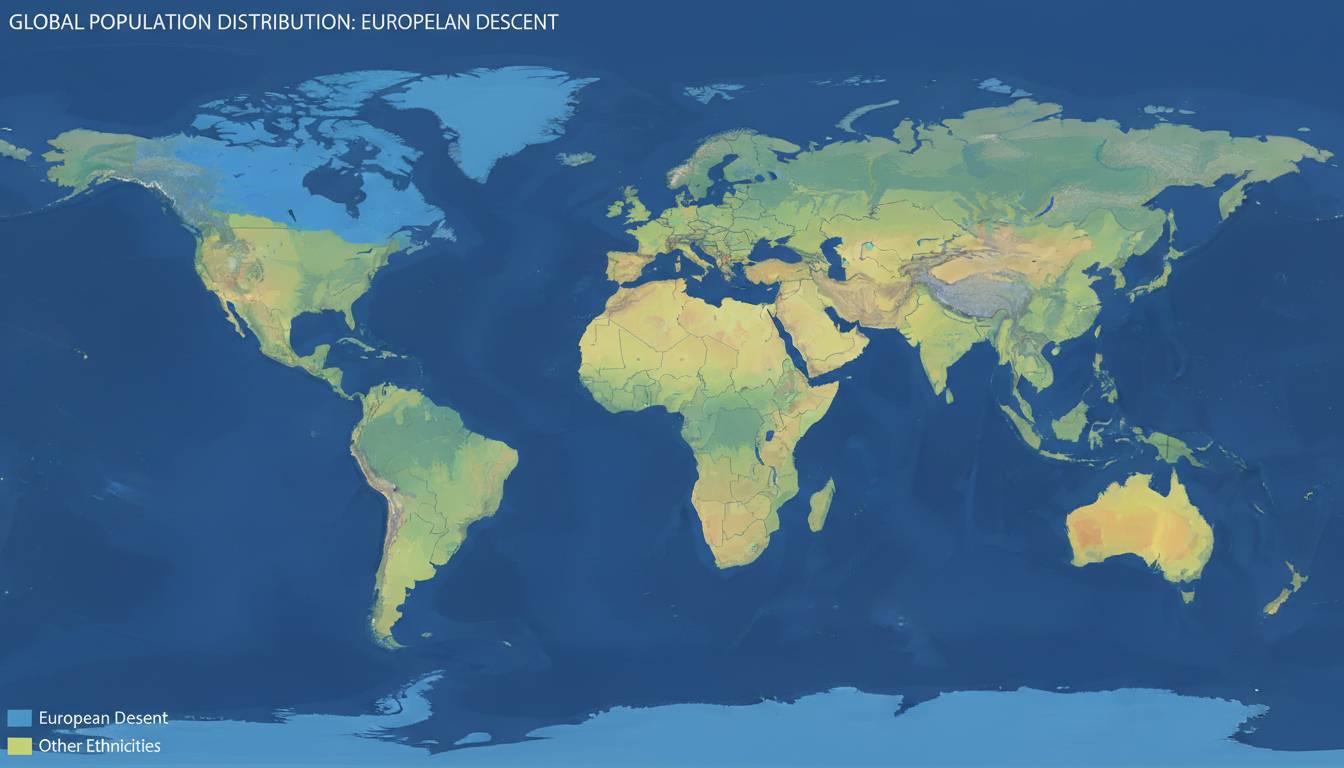

Determining exactly how many “white” people exist worldwide is surprisingly difficult because there’s no universal definition of who counts as white. Different countries, organizations, and censuses use vastly different criteria to classify race and ethnicity, making global statistics inconsistent and often misleading. The concept of “whiteness” itself is a social construct that has evolved over time and varies significantly across cultures and regions. Rather than providing a single number, this article explores the complexities of racial classification, how different nations track demographic data, and what current population trends tell us about global demographics.
The Challenge of Defining “White” Globally
The term “white” means something different depending on where you live. In the United States, the Census Bureau defines White people as those having origins in Europe, the Middle East, or North Africa. This broad definition includes millions of people who might not identify as white in other parts of the world. Meanwhile, many European countries don’t use “white” as a census category at all, preferring instead to track nationality, citizenship, or ethnicity without racial classification.
This inconsistency makes global counting problematic. What researchers call “European ancestry” or “Caucasian” doesn’t neatly map onto how people identify themselves in daily life. Someone of Spanish descent might check “white” on a US form but identify differently in their home country. The boundaries of racial categories shift based on historical, social, and political factors rather than any biological reality.
How Different Countries Track Race and Ethnicity
United States Census Approach
The US Census has asked about race since the first count in 1790, though the categories have changed dramatically over time. Currently, respondents can select one or more racial categories, with “White” being one of the largest groups. According to US Census Bureau data, approximately 196 million Americans identified as white alone in the 2020 census, representing about 59% of the total population. However, this number includes Hispanic white respondents, which creates some confusion about comparative statistics.
European National Statistics
Most European countries abandoned racial categorization in their censuses decades ago, influenced by historical atrocities committed using racial classifications. Instead, these nations track citizenship, nationality, and sometimes ethnicity for specific groups. In countries like France and Germany, collecting racial data is actually prohibited by law in many contexts. This approach reflects a desire to avoid the discriminatory practices of the past but creates challenges for understanding demographic shifts.
United Kingdom and Commonwealth Countries
The UK collects ethnic group data through surveys and censuses, using categories that include “White,” “Mixed,” “Asian,” “Black,” and “Other.” The 2021 Census showed that approximately 82% of England’s population identified as White, broken down into “White English, Welsh, Scottish, Northern Irish or British” and “White Other.” These classifications continue to evolve based on how populations identify themselves.
Global Population Distribution by Region
Understanding global demographics requires looking at population distribution rather than trying to assign a single “white” total. Europe, including Russia, has a population of roughly 750 million people. North America (US and Canada) adds another 370 million. Australia and New Zealand contribute about 30 million. Together, these regions with predominantly European-derived populations total approximately 1.15 billion people.
However, this straightforward calculation misses important nuances. It includes all residents of these regions regardless of racial identification, and it excludes people of European descent living in other parts of the world. Countries like Argentina, Brazil, Chile, and South Africa have significant populations of European ancestry alongside other ethnic groups. The boundaries become even murkier when considering mixed-race individuals, a growing category in many nations.
The Social Construction of Race
Anthropologists and sociologists widely agree that race is a social construct rather than a biological fact. Genetic research has shown that human populations aren’t neatly divided into distinct racial categories. The physical traits we associate with race, such as skin color, hair texture, and facial features, represent adaptations to different environmental conditions over thousands of years, not fundamental biological differences.
This understanding matters for demographic counting. When we try to tally “white” people globally, we’re applying a category that has different meanings in different contexts. In Brazil, for example, racial identification has historically been more fluid than in the United States, with people moving between categories across generations based on social and economic factors. The Brazilian census uses entirely different categories that don’t map onto US-style racial classifications.
Demographic Trends and Future Projections
Population projections suggest significant shifts in coming decades. Europe and North America are experiencing aging populations with relatively low birth rates, while populations in Africa, Asia, and Latin America are younger and growing faster. These trends mean that the proportion of people with European ancestry in the global population is likely to decrease over the coming century.
The United Nations projects that the global population will reach approximately 9.7 billion by 2050, with most growth occurring in Africa and Asia. As migration patterns shift and populations become more diverse through intermixing, traditional racial categories become increasingly difficult to apply consistently. Some demographers predict that by the mid-21st century, no single racial group will constitute a majority in countries like the United States.
Why Accurate Counting Matters (and Why It’s Difficult)
Accurate demographic data serves important purposes for policy-making, civil rights monitoring, and social understanding. Governments need to know about their populations to allocate resources, enforce anti-discrimination laws, and understand community needs. However, the methods used to collect this data can influence the results significantly.
Self-identification surveys produce different numbers than observer-assigned classifications. A person might identify as multiracial on one survey and select a single category on another. Some people with partial European ancestry may identify primarily with other racial groups, while others might select “white” despite diverse ancestry. These choices reflect family history, social context, and personal identity in complex ways that simple counting can’t capture.
“The categories we use to divide humanity reflect our history and our politics more than any biological reality. What we call ‘race’ tells us more about how societies have been organized than about inherent differences between people.”
The Complexity of Hispanic and Latino Identification
One area where counting becomes particularly tricky involves Hispanic or Latino identity, which the US Census treats as an ethnicity rather than a race. Many Hispanic individuals identify as “white” on US census forms, even though their ancestry may include indigenous, African, and European roots. In Latin American countries, the racial landscape differs dramatically from North American patterns, with many people identifying as mestizo (mixed European and indigenous) rather than exclusively white or non-white.
This creates statistical challenges when comparing “white” populations across the Americas. Someone counted as white in US statistics might identify differently in their country of origin, and vice versa. The fluidity of racial identification in Latin America reflects different historical experiences with colonialism and immigration than those in Anglo-American countries.
Conclusion
Rather than offering a single, misleading number, it’s more accurate to say that roughly 1 to 1.2 billion people live in regions where the majority population is of European descent, with significant additional populations of European ancestry in Latin America and other parts of the world. However, any figure claiming to precisely quantify “white” people globally should be viewed with skepticism given the vast differences in how racial categories are defined and applied across nations.
The bigger picture involves understanding demographic change as a complex, ongoing process. Population movements, intermarriage, and evolving identities all shape how societies look racially and ethnically. Rather than asking how many white people exist in the world, researchers increasingly focus on understanding these dynamic processes and their implications for societies worldwide.
FAQs
Why is it so difficult to get an exact number of white people globally?
There’s no universal definition of who counts as “white.” Different countries use different racial categories, and many nations don’t collect racial data at all. The concept of race itself varies significantly across cultural and historical contexts.
Does the US Census provide reliable white population statistics?
The US Census provides detailed data, but it reflects how Americans choose to identify rather than any objective racial standard. The category includes people with origins in Europe, the Middle East, and North Africa.
Are European countries tracking white populations?
Most European countries stopped collecting racial data decades ago. Many prohibit such collection by law, viewing it as potentially discriminatory following World War II experiences.
How is the global white population expected to change?
Demographic projections indicate that populations of European descent will make up a smaller percentage of the global population in coming decades due to lower birth rates in Europe and North America compared to other regions.
What percentage of the world is of European descent?
Roughly 15-18% of the global population lives in regions dominated by European-derived populations (Europe, North America, Australia), though this includes all residents regardless of individual ancestry.
Why do demographic categories matter?
Categories matter because they affect civil rights monitoring, resource allocation, political representation, and social understanding. However, the categories we use are social constructs that evolve over time.






Leave a comment